Showing posts with label autumn. Show all posts

Thursday, December 27, 2018

The Straw Mattress


Moving to a new house, we found ourselves in need of a mattress. Given the problems with buying one new (expensive, toxic, resource intensive) and the desire to make things ourselves from simple materials, we decided to try making one from straw. There wasn't very much information on this online (except for this awesome article), but it seemed worth trying. I sewed a tick (the cloth casing) from thick cotton canvas curtains I found at a thrift store plus a few more yards from a fabric store. I spent about $20 on fabric altogether. Then we stuffed it with straw. It took 2-3 bales of straw to fill the tick, including discarded straw (it had rained the day I got the bales and some of the straw was damp). We did this just before Halloween, so we were able to get bales of straw for just $4 each from a church display selling pumpkins.

straw mattress tick stuff

straw mattress tick stuff
Stuffing the tick.

straw mattress tick stuff
Fully stuffed mattress, looking comically overstuffed.

straw mattress tick stuff
The finished straw mattress more compressed.

After sleeping on this mattress for two months, I will call it a success! It was inexpensive and easy to make. The most time-intensive part was designing and sewing the tick. I find it very comfortable and cozy. The straw is fluffy when you first lay on it, but quickly compresses down into a more firm texture. One big difference between the straw mattress and a conventional mattress is that the straw mattress is not "springy". Jumping on the bed does not have the same effect. It also has a tendency to develop an uneven surface, making a little "nest" where your body lays. The mattress can be re-fluffed as often as you'd like to make the straw fluffy and more even again. Or you can enjoy the firmer and pre-formed nest! Overall, if you are considering giving the straw mattress a try, in my experience at least, it is absolutely worth it.

Thursday, August 31, 2017

A Calendar for the Willamette Valley


January
February
March
April -- Maple Moon (when Bigleaf maples expand their leaves)
May
June
July
August -- Blackberry Moon (when blackberries ripen)
September
October
November
December

To be updated!!

Saturday, December 3, 2016

Sauerkraut revisited

I made my first batch of sauerkraut in December of 2009. Since that experiment I've had many successful ferments (and started using a real fermenting crock rather than a fish bowl), but my most recent batch may just be an epic failure.

Making a tasty ferment is always a combination of factors -- temperature, bacteria, and timing all play together in a chemical, biological dance. Prior to my most recent batch, I'd only made my kraut in the Pacific NW fall; a fall with reliably high humidity. But a reliable characteristic of my current home is aridity. 

On a sunny fall day I sought out a pair of hefty cabbages at the Santa Fe farmer's market. I cradled them like babies, brought them home, and did the usual -- fine chopping, squishing with salt, and packing into my 2 gallon crock. I was impressed with the brine created from the cabbage's liquid. It covered the cabbage by a couple inches, so I didn't need to add any additional brine. 

Fast forward a few days, and I check on my kraut. All of that beautiful brine evaporated! The cabbage was exposed to air, and I needed to add more liquid. Somewhere in my head I knew that I should add a brine solution (water + salt) and not just plain water. The correct salt concentration discourages the growth of gross bacteria. But I was feeling extra experimental that fateful day, or overly confident in my healthy batch of kraut, or lazy, and I decided to use plain tap water to resubmerge the cabbage. 

Fast forward a few more days, and the kraut has an amazingly hairy growth of mold. I scoop it out with a big spoon, and the whole mat clings together like a weird kombucha scoby. I dig deeper into the crock and happily find that its innards are crunchy, delicious, and developing excellent kraut sourness and flavor. I fill a jar for the fridge, then pack the rest back together and place the crock gently in its fermenting corner, confident that it will be a fine batch.

But then the jar in the fridge grows soft. I fear for the whole batch, and open it (after 40 days at ~60-70 degrees F). It seems softer than normal. But it's tangy. And the smell is... interesting? I swear I detect notes of chocolate, but then I have a weird nose. All of this begs some questions: can soft sauerkraut be okay? and are my vague memories of someone telling me about their grandmother's sauerkraut crocks, and how they had a layer of mold, true? If the kraut is delicious, I will eat it. Go bravely into your fermenting future!


Sunday, November 8, 2015

Fall Flowers

Caught a whiff of something just like spring, and found these flowers blooming in October.

flower

Tuesday, March 3, 2015

How Spring Happens Here, Part One: Old leaves, new leaves

In our mild Pacific Northwest winters, some plants keep a portion of their leaves all through that rainy season. It's as if, in the fall, environmental signals aren't quite harsh enough to push plants into total dormancy. In spring, bursting buds push out fresh growth to contrast with the leaves still left from last year.


(Questions: how much energy is gained from wintered-over leaves? seems introduced plants from harsher climates are most likely to display this pattern, true? is there a pattern (location?) as to which leaves are kept? and, when are these kept leaves finally lost?)

Thursday, December 11, 2014

Circling


Today my patch of urban forest felt like the BIG woods. Shortly after noon I set out for a short loop hike; the sky was clear and blue, and I could pinpoint the location of the sun in the sky: low, as we near the winter solstice. The air was sunny and warm, yet creeks were noisy with recent rainstorm run-off. This unusual combination took my imagination to much, much larger forest systems.

As I left the canopy to return to boxes and paved streets, I saw chunks of cloud flying north across the sky, then a grey mass covered the recently sunny southern sky. A REALLY gusty system blew in.

~~~~~~~~~~~~~~~

As I move about the city by foot or bike, I often experience conflicts with motorized traffic, much of it mental (or nasal, but that's another story). Why do we devote our cities to over-sized, noisy, stinky machines? My attitudes range from fear, to aggression, to imagining traffic as a great herd of metal cattle. Recently, this story jumped to mind and seemed most apt (retold in my own words as I don't know the source):

One day, the wind said to the sun, "See that woman there? I bet you I can take off her big coat."
So the wind blew down upon the woman, but she only tightened up the buttons on her coat. The wind blew harder, but she wrapped her arms about herself.
Then the sun said, "Let me try." He looked out from behind a cloud, and the woman relaxed her arms. He stepped full into the sky, warming everything below, and the woman took off her coat.

~~~~~~~~~~~~~~~

winter here
curl into a ball under covers
gently hold my heart

think of ice mountains
on a scale i can not fathom
be still, till clarity of mind returns

(journal entry Nov. 2010)

Monday, September 22, 2014

Equinox

The season is turning. A few weeks ago, a fresh layer of dropped leaves on the urban forest floor caught me by surprise -- most of them were still green.
 

It had been rather windy... but did the bigleaf maples care about the greenness they had yet to take back?


Some of that green is wanted by someone; they munched out the tasty softer bits between the veins of this red alder leaf.


Just a few days later, actual canopy color change seemed to hit the maples all at once.


While many things expanded to huge this summer season, not everything reached its full potential. As I began preparing a long neglected summer garden for its next season, this tiny cucumber was discovered beneath larger leaves.

Saturday, July 12, 2014

season rolls on

In the forest, Oemleria is letting go of her leaves. Fast to get started on spring, quick to begin fall...
oemleria yellow leaves from below
oemleria fall leaves sunbeam

While thimbleberry still has scars from a spring hailstorm.
 thimbleberry leaf holes
In the garden, pumpkins have long outgrown their hole-punched leaves, zucchinis hide and grow to surprising size + first ripe tomato!

Monday, December 9, 2013

Tepee Attempt

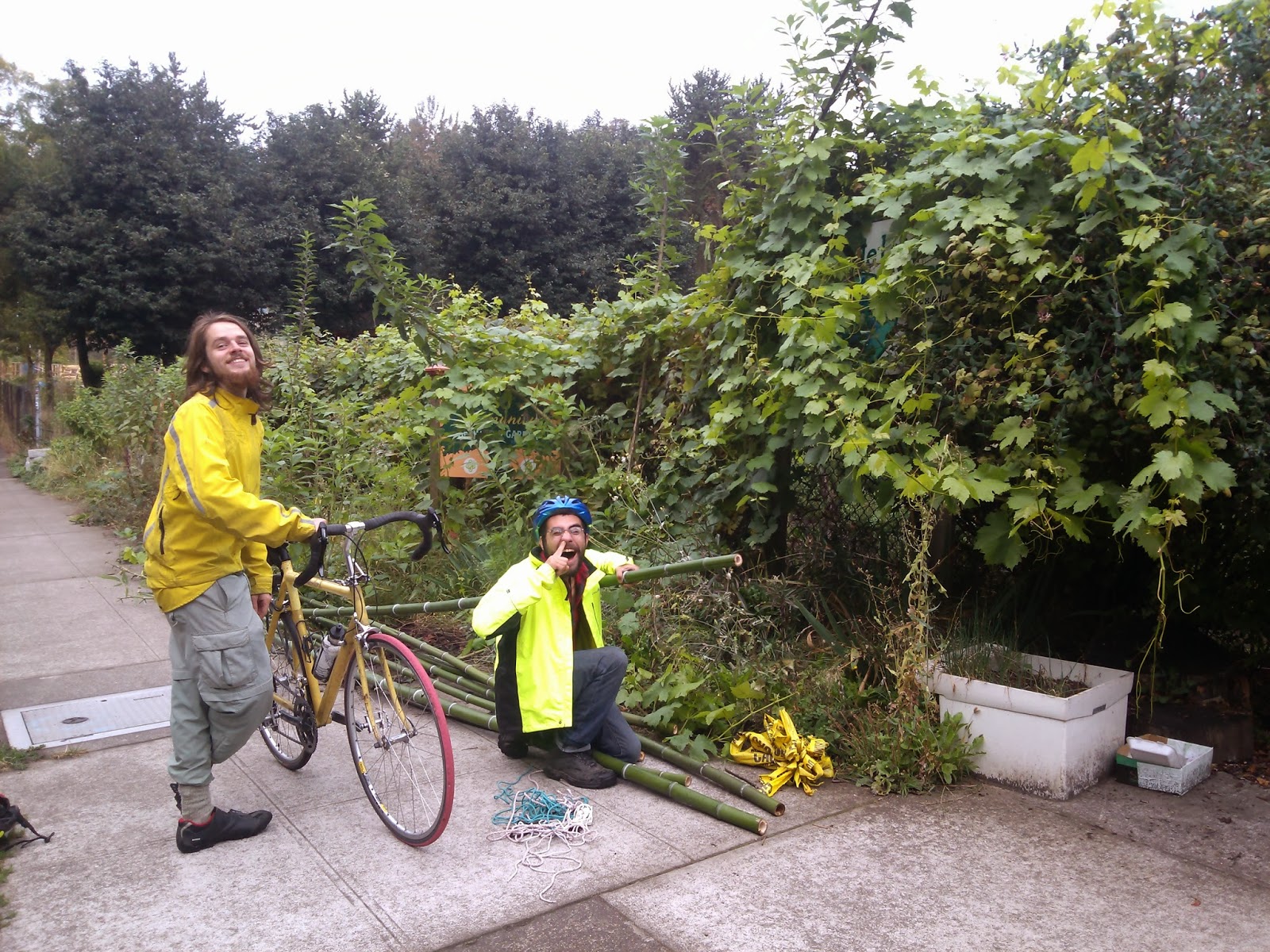
Tried to build a tepee this summer. The quest to recreate the simple, mobile, and graceful shelter of the Plains tribes is a recurring theme for me, and while this iteration didn't get lived in, at least it's an adventure worth sharing.
fun friends hauling bamboo by bike
To begin, I had the help of two friends. Excellent bike handling skills and a sense of humor were required for the task ahead.

 We secured four giant bamboo poles on each of two bikes and set off to ride 5 miles through the city to the north.

haul bamboo by bike


 Motorized traffic was light on that Sunday morning, but there was still enough foot traffic to provide an audience. One man expressed the notion that bamboo carried by bike is more 'sustainable' than anything else in existence. This may be true.


bamboo tepee
Arranged into formation, the bamboo took on that beautiful form of a giant cone!


bamboo tepeebamboo tepee
View from below.


bamboo tepee slug trail
Blue plastic provided a covering and a canvas for slug meanderings.

bamboo tepee
And it stood, reflecting the color of the sky.

Thursday, October 31, 2013

Sunday, October 13, 2013

Fall Planting 10.13.13

Warm in the sun today, forecast the same.
Green beans doing their last. Planted summer-grown seeds of kale, radish, fava, parsley, cilantro, and pea. Serendipitous gift of elephant garlic, I shoved it into the ground too. Warmth will fool me as well as the seeds into extra action before true winter cold sets in.

Thursday, October 10, 2013

Northern Willamette

Last week in September, a typhoon blew in. And blew through, uncovering blue skies and leaving the river muddy brown.

Friday, November 2, 2012

Fall 2007

A poem from 5 autumns ago ~

it's fall
and the season seems more real than
the mailman or the bus
they are like glass blocks
their movements following invisible thread
apparitions in nature's autumn

Thursday, December 30, 2010

Blueberry Leaves


red blueberry leaf

Why do leaves turn colors before dropping off in the fall? These are blueberry leaves (genus Vaccinium) . They're red where they received sun, but yellow where they were covered by another leaf.


red blueberry leaf


Maybe the red is a pigment that helps with photosynthesis, but also works as a sunscreen. Perhaps the green pigments are able to be reabsorbed by the plant, but the reds aren't. But if during the summer both pigments are in the leaf, how does the green cover up the red? Perhaps the green changes to red in the fall.

I wonder what they looked like during the summer.


red blueberry leaf

Thursday, November 18, 2010

Fava Beans


fava beans
Fava beans, flourishing in the fall, killed with the first hard frost.