Showing posts with label craft. Show all posts

Thursday, December 27, 2018

The Straw Mattress


Moving to a new house, we found ourselves in need of a mattress. Given the problems with buying one new (expensive, toxic, resource intensive) and the desire to make things ourselves from simple materials, we decided to try making one from straw. There wasn't very much information on this online (except for this awesome article), but it seemed worth trying. I sewed a tick (the cloth casing) from thick cotton canvas curtains I found at a thrift store plus a few more yards from a fabric store. I spent about $20 on fabric altogether. Then we stuffed it with straw. It took 2-3 bales of straw to fill the tick, including discarded straw (it had rained the day I got the bales and some of the straw was damp). We did this just before Halloween, so we were able to get bales of straw for just $4 each from a church display selling pumpkins.

straw mattress tick stuff

straw mattress tick stuff
Stuffing the tick.

straw mattress tick stuff
Fully stuffed mattress, looking comically overstuffed.

straw mattress tick stuff
The finished straw mattress more compressed.

After sleeping on this mattress for two months, I will call it a success! It was inexpensive and easy to make. The most time-intensive part was designing and sewing the tick. I find it very comfortable and cozy. The straw is fluffy when you first lay on it, but quickly compresses down into a more firm texture. One big difference between the straw mattress and a conventional mattress is that the straw mattress is not "springy". Jumping on the bed does not have the same effect. It also has a tendency to develop an uneven surface, making a little "nest" where your body lays. The mattress can be re-fluffed as often as you'd like to make the straw fluffy and more even again. Or you can enjoy the firmer and pre-formed nest! Overall, if you are considering giving the straw mattress a try, in my experience at least, it is absolutely worth it.

Saturday, December 3, 2016

Sauerkraut revisited

I made my first batch of sauerkraut in December of 2009. Since that experiment I've had many successful ferments (and started using a real fermenting crock rather than a fish bowl), but my most recent batch may just be an epic failure.

Making a tasty ferment is always a combination of factors -- temperature, bacteria, and timing all play together in a chemical, biological dance. Prior to my most recent batch, I'd only made my kraut in the Pacific NW fall; a fall with reliably high humidity. But a reliable characteristic of my current home is aridity. 

On a sunny fall day I sought out a pair of hefty cabbages at the Santa Fe farmer's market. I cradled them like babies, brought them home, and did the usual -- fine chopping, squishing with salt, and packing into my 2 gallon crock. I was impressed with the brine created from the cabbage's liquid. It covered the cabbage by a couple inches, so I didn't need to add any additional brine. 

Fast forward a few days, and I check on my kraut. All of that beautiful brine evaporated! The cabbage was exposed to air, and I needed to add more liquid. Somewhere in my head I knew that I should add a brine solution (water + salt) and not just plain water. The correct salt concentration discourages the growth of gross bacteria. But I was feeling extra experimental that fateful day, or overly confident in my healthy batch of kraut, or lazy, and I decided to use plain tap water to resubmerge the cabbage. 

Fast forward a few more days, and the kraut has an amazingly hairy growth of mold. I scoop it out with a big spoon, and the whole mat clings together like a weird kombucha scoby. I dig deeper into the crock and happily find that its innards are crunchy, delicious, and developing excellent kraut sourness and flavor. I fill a jar for the fridge, then pack the rest back together and place the crock gently in its fermenting corner, confident that it will be a fine batch.

But then the jar in the fridge grows soft. I fear for the whole batch, and open it (after 40 days at ~60-70 degrees F). It seems softer than normal. But it's tangy. And the smell is... interesting? I swear I detect notes of chocolate, but then I have a weird nose. All of this begs some questions: can soft sauerkraut be okay? and are my vague memories of someone telling me about their grandmother's sauerkraut crocks, and how they had a layer of mold, true? If the kraut is delicious, I will eat it. Go bravely into your fermenting future!


Saturday, April 4, 2015

Phylogeny of the Boxes

box phylogeny
Box: that which contains (particularly with straight lines and right angles).
Sometimes the human world seems like just a series of nested containers.
What exactly are we containing?

Monday, December 9, 2013

Tepee Attempt

Tried to build a tepee this summer. The quest to recreate the simple, mobile, and graceful shelter of the Plains tribes is a recurring theme for me, and while this iteration didn't get lived in, at least it's an adventure worth sharing.
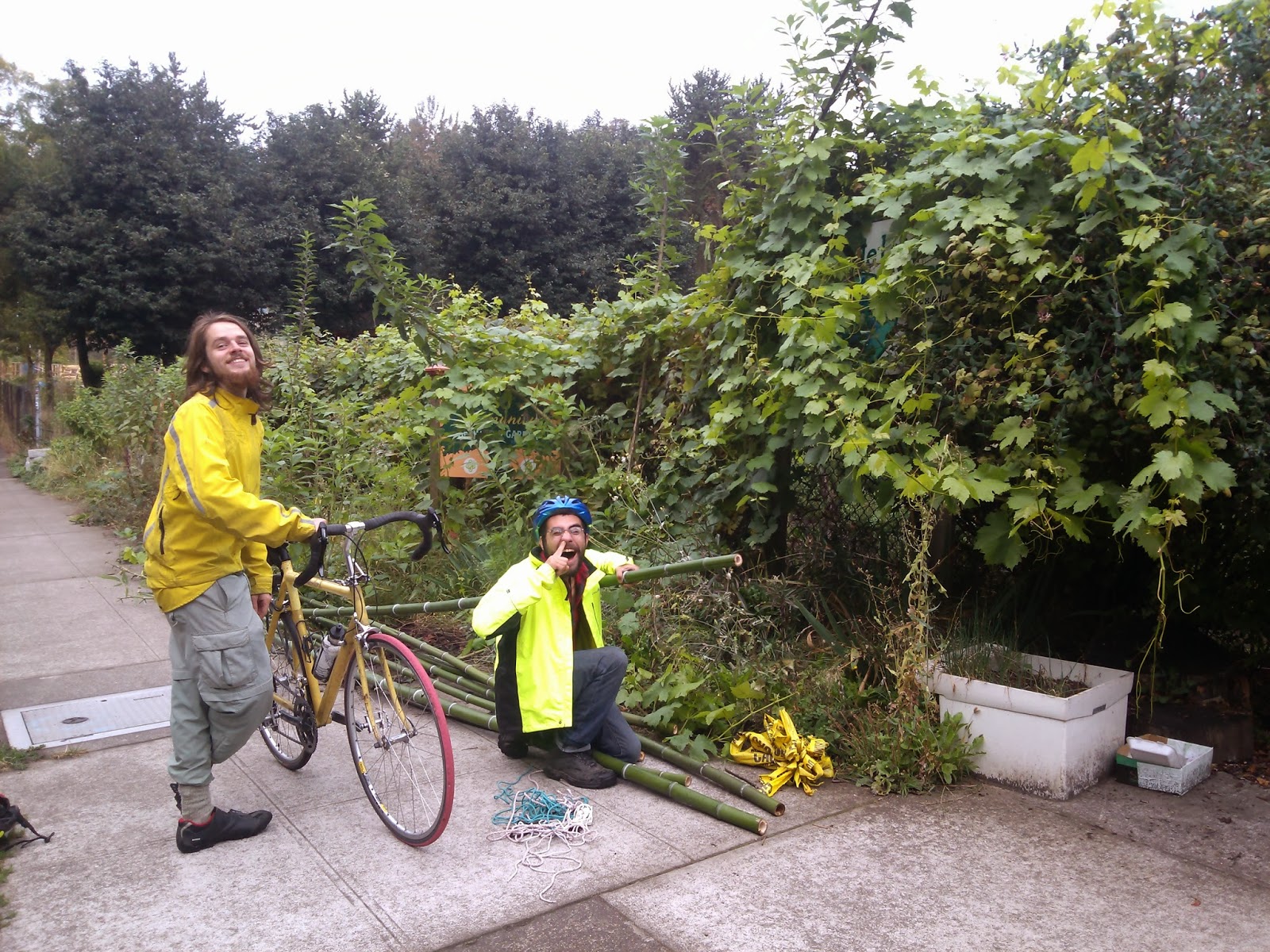
fun friends hauling bamboo by bike
To begin, I had the help of two friends. Excellent bike handling skills and a sense of humor were required for the task ahead.

 We secured four giant bamboo poles on each of two bikes and set off to ride 5 miles through the city to the north.

haul bamboo by bike


 Motorized traffic was light on that Sunday morning, but there was still enough foot traffic to provide an audience. One man expressed the notion that bamboo carried by bike is more 'sustainable' than anything else in existence. This may be true.


bamboo tepee
Arranged into formation, the bamboo took on that beautiful form of a giant cone!


bamboo tepeebamboo tepee
View from below.


bamboo tepee slug trail
Blue plastic provided a covering and a canvas for slug meanderings.

bamboo tepee
And it stood, reflecting the color of the sky.

Wednesday, January 27, 2010

More Fermented Vegetables


I started three new jars of "sauerkraut" last week. This time I used more than just cabbage and salt. In the jar on the left I included beet, carrot, onion, and apple with the cabbage. The middle jar has eggplant and cabbage, and the jar on the right has brussels sprouts, broccoli, cauliflower, and cabbage. Each jar also includes several spices: caraway, juniper, black pepper, red pepper, coriander, or curry. I had a lot of juice left after I ate all of the earlier-made sauerkraut, so I also added that to each of these jars. Other than the salt in that brine, very little extra salt was added (only a few pinches to the eggplant mixture). The tasting has barely begun, but I think I may have been too heavy with the spices. These might have to be condiments rather than side dishes.

Tuesday, January 5, 2010

Book Binding


An image of journals I have made. It takes me half an hour to an hour to put one all together. I use these as agendas, for taking notes, or for general writing. They're really quite simple... all you need is paper, string, and a needle (other things like cardboard, cloth, glue, or tape are optional).

Wednesday, December 30, 2009

Pioneer Skills

Things I have made, am making, or would like to make (in no particular order):

foods:
cheese (fast, slow, goat, cow)
yogurt
sauerkraut
kombucha
bread/sourdough
kefir
amazake
idlis
vinegar
cider wine
capers (from nasturtium or oxeye daisy flower buds)

textiles:
string/rope (from nettle, cedar)
yarn
a drop spindle
a spinning wheel
a quilt/blankets
pants, clothes in general by sewing
jackets/sweaters, gloves & socks by knitting
hats (woven, knitted, crocheted, sewn, felted)
shoes/boots/moccasins/sandals
snowshoes
bags/backpacks
 
toothpaste
shampoo
tinctures
essential oils
calendula yarrow salve

baskets from pine needles/grasses/willow-like sticks
clay pots, teapot, dishes. tiny clay pots to store salve

at the forge:
a sword, knives
shovel
hooks with corkscrew end

arrowheads/knives/spear points (by flintknapping)
a bow
skin-on-frame kayak
a compass using simple materials
fire (with hand drill or bow drill)
candles (both the kind in a container that are filled, and the tall kind that are dipped)
oil lantern
journals (blank books)

larger:
greenhouse/glass house
a wickiup
functional tepee
a root cellar
a new variety of garden vegetable
massive herb garden, complete with boulders
compost/soil

What can I add to my list?

Monday, December 28, 2009

Making Sauerkraut


I started on December 19th with one 4.7 pound green cabbage purchased from the Farmer's Market for two dollars. I chopped it up into long shreds and placed it in a large metal bowl, added sea salt and mixed it together, purposely bruising the cabbage in the process to get it to begin releasing water. I read in several places online that the accepted ratio of cabbage to salt is 5 pounds to 3 tablespoons, so I used a little less than 3 tablespoons. I then packed the cabbage and salt mixture into a glass fishbowl (the largest glass container I could find). I wasn't satisfied with the amount of brine that was created by the cabbage juice and salt mixture, so I mixed more sea salt into some distilled water and added that (using the amount of salt that I thought would be enough to keep bad germs from growing, but not so much that it would taste too salty to eat). I put a bowl on top of the cabbage to raise the brine level above the cabbage, covered the fishbowl with plastic wrap and a rubberband, and hoped the microbes would make me something tasty. Following are daily notes on its progress:

One day later: ~68 (degrees Fahrenheit). Cabbage-y smell. Bubbles that look like spit on the surface of the brine. I covered the fishbowl with a t-shirt to keep it dark (read somewhere that it should be dark).

Two days later: ~66. Bubbles this morning. Very strong sulfur smell. Tastes sweet and salty (sweet cabbage, salty salt).

Three days later: Tastes less sweet. Beginning to smell a hint of sour. Water is a little cloudy.

Four days later: ~62. Smells much more sour, still bubbling.

Five days later: ~64. Seems to be bubbling less. Tastes quite sour.

Six days later: ~66. Seems to have stopped bubbling altogether.

Eight days later: ~63. Fragrantly sour. Time to start eating it.

I'm surprised by how the sauerkraut no longer tastes salty. I know there's a lot of salt in it, but the sour flavor must be masking it. Also, the smell produced as the bubbles were released was very strong and smelled like sulfur. I read on one site that if your kraut smells bad, you shouldn't eat it. Well, that certainly smelled bad but I stuck with it and I think my finished product is fine (it tastes good and I'm not sick). I wonder how many people have started making sauerkraut but threw it out thinking something had gone wrong.

Pictured at the top is my sauerkraut in the fishbowl and below is the same fishbowl covered by a shirt, with some of the kraut that I transferred to a different jar. The jar is in a plastic tub so that when I push on the other jar that fits inside of it to push bubbles out of the cabbage, the brine doesn't spill onto the carpet. The other object is a thermometer.