Daffodils and Oemleria blooming - classic and sure signs of spring in Portland, OR
Showing posts with label leaves. Show all posts
Wednesday, February 24, 2016
Monday, April 6, 2015
How Spring Happens Here, Part Two: Canopy closure
If we were to rename the local months in the style of Native Americans, April might be Moon of Bigleaf Expansion. Now the year's crop of giant leaves of Bigleaf maple (Acer macrophyllum) is small but rapidly expanding; now the leafy curtain partitioning interior urban forest from exterior is unfolding.
Tuesday, March 3, 2015
How Spring Happens Here, Part One: Old leaves, new leaves
In our mild Pacific Northwest winters, some plants keep a portion of their leaves all through that rainy season. It's as if, in the fall, environmental signals aren't quite harsh enough to push plants into total dormancy. In spring, bursting buds push out fresh growth to contrast with the leaves still left from last year.
(Questions: how much energy is gained from wintered-over leaves? seems introduced plants from harsher climates are most likely to display this pattern, true? is there a pattern (location?) as to which leaves are kept? and, when are these kept leaves finally lost?)
Saturday, December 27, 2014
Monday, September 22, 2014
Equinox
The season is
turning. A few weeks ago, a fresh layer of dropped leaves on the urban forest floor caught me by surprise -- most of them were still green.
It had been rather windy... but did the bigleaf maples care about the greenness they had yet to take back?
Just a few days later, actual canopy color change seemed to hit the maples all at once.
While many things expanded to huge this summer season, not everything reached its full potential. As I began preparing a long neglected summer garden for its next season, this tiny cucumber was discovered beneath larger leaves.
It had been rather windy... but did the bigleaf maples care about the greenness they had yet to take back?
Some of that green is wanted by someone; they munched out the tasty softer bits between the veins of this red alder leaf.
Just a few days later, actual canopy color change seemed to hit the maples all at once.
While many things expanded to huge this summer season, not everything reached its full potential. As I began preparing a long neglected summer garden for its next season, this tiny cucumber was discovered beneath larger leaves.
Saturday, July 12, 2014
season rolls on
In the forest, Oemleria is letting go of her leaves. Fast to get started on spring, quick to begin fall...
While thimbleberry still has scars from a spring hailstorm.
In the garden, pumpkins have long outgrown their hole-punched leaves, zucchinis hide and grow to surprising size + first ripe tomato!
While thimbleberry still has scars from a spring hailstorm.
Sunday, June 15, 2014
Petal Sepal Confusion
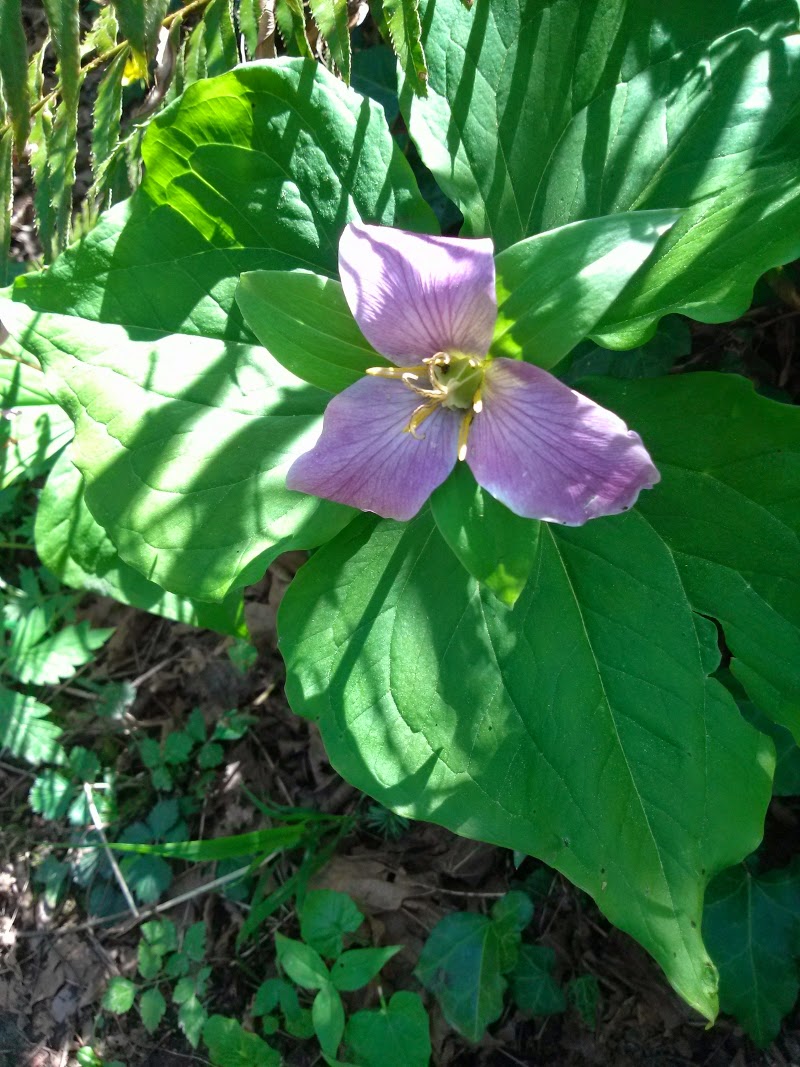
How do plants keep petals and sepals separate? I found a trillium (Trillium ovatum) that doesn't.
This is a trillium, its three originally white petals fading pink in late spring. The petals rest on three pointed green sepals. Below the flower are three large photosynthetic organs, which I just learned are technically not leaves, but bracts!
And this is a trillium that looks to have merged its petals and sepals into one structure. Huh.
This is a trillium, its three originally white petals fading pink in late spring. The petals rest on three pointed green sepals. Below the flower are three large photosynthetic organs, which I just learned are technically not leaves, but bracts!

And this is a trillium that looks to have merged its petals and sepals into one structure. Huh.
Friday, February 28, 2014
Nettles 2014
Last day of February, new moon, mostly sunny and rather warm. Snowberry (Symphoricarpos albus) letting out tiny leaves, Indian plum (Oemleria cerasiformis) raising amazing candelabras of flame-green leaves.
And nettles -- still slightly small, but their unique flavor strong and welcome: stings into spring!
(Things are a little slower than 2010 so it seems)
And nettles -- still slightly small, but their unique flavor strong and welcome: stings into spring!
(Things are a little slower than 2010 so it seems)
![]() |
| Spring Indian plum candelabra |
![]() |
| Nettling grounds |
![]() |
| Stinging nettles (Urtica dioica) |
Saturday, February 15, 2014
Marquam in the Snow
Notice the rhododendron leaves above my bike - they're tucked down and curled under - yes, it was very cold.
Immediately adjacent to machine madness, Marquam was calmly taking on the light dusting.
Usually bright, smiling, and green in cool, wet winter weather, licorice fern curled up in the cold. Was it simply drying out, or utilizing dry weather for spore dispersal, or both? Anyway, check out those sori!
The next day, we had accumulation.
Mini-mountains of snow mounded on spiky holly leaves.
This is a snow-topped, ivy-covered snag of some sort. Strange beast.
On Monday, things began to melt. Sheets of ice were slipping from the Marquam shelter roof.
And by Tuesday, the snow had its sentencing - warmer temperatures were in. Many urban streams were running chocolate-mud brown.
A record of strong foot traffic was kept by the snow... despite, or because of, the snow.
Thursday, January 16, 2014
After windy woods
Went for a walk a few days ago after a windy night in the urban forest.
Lots of material had been shook loose from the canopy. Including this nest:
Ivy is showing its winter colors.
While licorice fern stays a light green.
The sun shines briefly but brightly through the cold, open canopy.
So, this is my first attempt to layer a short exposure over a long exposure to create an image with more depth. It's just slightly unaligned.
Thursday, June 20, 2013
gardens still growing
My small plot at the PSU community garden is a micro-patch of vegetable plants turned jungle these days. Kale, parsley, chard, and carrot hold flowers and seeds on stems much taller than I, pea vines finding their way through the mess, california poppy and st. johns wort flowers lighting up the understory. The dish of water I normally maintain at center has become swamp, but fresh water is still to be found - as in this dock leaf cupping rain water into a tiny lake:
So overgrown it has become, fairies actually moved in. Can you believe that?
This is the view from their skylight
And these carrot flowers float about in great balls like spaceships made of snow, releasing drifts of powdery pollen
Back at the other garden plot, giant-vegetable-dreams are realized in this fabulous lettuce (key included for scale).
Delicious beet success, short of soccerball-size, not short on sweet
Beets and Kale, a variety of leaf texture
Lentils! Handful of dry lentils thrown in the dirt... add water, time, warmth and sun - the seeds show some of their programmed secrets. Fine leaves and tiny pods, nice to meet you long-eaten staple.
Thursday, December 30, 2010
Blueberry Leaves
Maybe the red is a pigment that helps with photosynthesis, but also works as a sunscreen. Perhaps the green pigments are able to be reabsorbed by the plant, but the reds aren't. But if during the summer both pigments are in the leaf, how does the green cover up the red? Perhaps the green changes to red in the fall.
I wonder what they looked like during the summer.
Subscribe to:
Posts
(
Atom
)